Introduction:
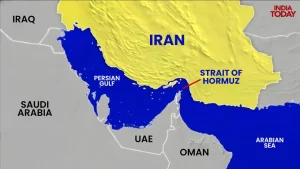
The modern international order is no longer defined by the steady march of globalization, but by a violent “rupture.” For the Gulf states, this shift is not theoretical; it is being played out in the volatile waters of the Strait of Hormuz. As the rivalry between global superpowers intensifies and the threat of direct conflict with Iran looms, the Gulf states face a foundational dilemma: continue a legacy of strategic subordination to external protectors or forge a perilous path toward true autonomy. The crisis in the Strait of Hormuz—and the broader confrontation with Iran—forces Gulf states into a stark strategic dilemma that goes far beyond immediate security concerns. It is not simply a question of how to respond to military escalation, but how to position themselves in an international system that no longer offers reliable protection to smaller powers. What is unfolding is a test of whether these states can transition from managed dependence to meaningful autonomy, or whether they will be compelled into deeper subordination under competing great powers.
For decades, Gulf states operated within the framework described by Mark Carney: a supposedly rules-based order that promised stability through economic interdependence and institutional governance. (1) In reality, as he has pointed out, this system always contained an imbalance of power. Echoing Thucydides, the strongest states shaped the rules, enforced them selectively, and bent them when necessary. For smaller and mid-sized states, survival often depended on alignment rather than independence. (2)
However, that strategy is now under strain. The current crisis in the Strait of Hormuz—the world’s most important oil transit chokepoint—reveals that the “rules” are now selectively enforced. In this new era of geoeconomic confrontation, trade and energy supply chains have been weaponized. For the Gulf, the realization is stark: the international system is no longer a neutral arbiter of peace, but an arena where the strong do what they can, and the weak suffer what they must. Additionally, the crisis has become a pressure point where disruption, whether through direct conflict with Iran or indirect escalation, is threatening not just oil exports but the broader economic models of Gulf states. At the same time, the global environment surrounding this crisis has fundamentally changed. The rivalry between the United States and China has transformed the international system into a fragmented and competitive landscape. Economic tools—sanctions, financial restrictions, technology controls—are now routinely weaponized. In such a world, neutrality is increasingly difficult to maintain. Every strategic choice risks entanglement.
This is where the core dilemma emerges: autonomy versus subordination.
Autonomy would require Gulf states to diversify their security partnerships, reduce overdependence on any single external power, and build indigenous capabilities—military, economic and technological. It would also mean pursuing more independent foreign policies, even if that involves balancing relations with actors like Iran, China, and the United States simultaneously. Autonomy offers resilience, but it comes with costs: higher defense spending, political risk, and the possibility of facing crises without guaranteed external backing.
Subordination, by contrast, offers short-term security guarantees. Aligning closely with a dominant power—historically the United States—can provide military protection and deterrence against regional threats. But in the current environment, such alignment is no longer neutral. It can draw Gulf states into broader geopolitical conflicts, expose them to economic retaliation from rival powers, and limit their strategic flexibility. As Stephen Walt notes, reliance on external balancing can also reduce strategic flexibility and increase exposure to the patron’s conflicts. Furthermore, dependence also becomes more precarious when the protecting power itself is recalibrating its global commitments. (3) The challenge is compounded by the region’s historical pattern of adaptation. As suggested through the analogy to Václav Havel’s “greengrocer,” Gulf states have often managed external pressures through symbolic alignment—publicly affirming dominant norms while quietly pursuing their own interests. This strategy worked in a relatively stable, rules-oriented system. It is far less effective in a fragmented order where ambiguity is interpreted as weakness and where great powers demand clearer loyalty.(4)
The Path Ahead: Choosing Autonomy
The rupture of the global system means that passive safety is an illusion. For the Gulf states, the choice is no longer between different protectors, but between Autonomy and Subordination. To pursue autonomy, the Gulf states must first confront a persistent internal constraint: political fragmentation. A divided Gulf remains highly permeable to external influence, its rivalries and asymmetries inviting intervention by stronger powers. By contrast, a more coordinated Gulf—if not fully unified—would be far better positioned to shape the terms of its own security rather than merely react to pressures imposed from outside. In the emerging world order environment, autonomy is not simply a preference; it is becoming a condition for long-term survival. Achieving this shift requires more than rhetorical commitment. It demands structural change across three interrelated dimensions:
- Reassessing Alignments: Gulf states must move beyond binary strategic logics that frame choices as a zero-sum alignment between East and West. The intensifying rivalry between global powers makes rigid alignment increasingly risky. Instead, a flexible, multi-vector foreign policy—one that preserves ties with the United States while expanding economic and diplomatic engagement with China and other actors—offers a more resilient path. Autonomy here does not mean neutrality, but calibrated positioning.
- Economic Diversification: The current economic model, heavily reliant on hydrocarbon exports and global financial integration, exposes Gulf states to what scholars call “weaponized interdependence.” As Henry Farrell and Abraham Newman argue, networks of trade and finance can be turned into instruments of coercion. Reducing this vulnerability requires accelerating diversification—developing non-oil sectors, regional supply chains, and technological capabilities that insulate domestic stability from external shocks. (5)
- Active Defense: Finally, autonomy requires a shift from symbolic security practices to material capability. The long-standing approach—what Václav Havel metaphorically framed as “performing rituals” of compliance—must give way to credible deterrence. This includes investing in indigenous defense industries, enhancing regional military coordination, and building the capacity to respond to threats without immediate reliance on external intervention.
Conclusion: Taken together, these shifts signal a movement from adaptive dependence toward genuine strategic agency. They do not eliminate risk—nor should they be expected to—but they create the conditions for Gulf states to navigate an increasingly volatile international system on their own terms, rather than at the discretion of external powers. In a world more closely resembling the logic described by Thucydides, the ability to act independently is no longer optional; it is foundational to resilience. The crisis in the Strait of Hormuz should therefore be understood not merely as a moment of danger, but as a catalyst for overdue transformation. It exposes the costs of deferring hard choices and underscores the urgency of recalibrating policy before future crises impose those choices under even less favorable conditions. Gulf states now face a defining decision: whether to invest in long-term autonomy—with all its inherent uncertainty—or to deepen reliance on external guarantees that are increasingly conditional, contested, and potentially unreliable. In this sense, the crisis extends far beyond Iran or maritime security. It marks a turning point in the political evolution of the Gulf itself. The longstanding model—prosperity under protection, integration without vulnerability—has fractured under the weight of systemic change. What emerges in its place will depend on how effectively these states manage the enduring tension between autonomy and subordination in an international order where, as emphasized by Mark Carney, power is once again overtaking rules as the primary determinant of outcomes.
- World Economic Forum.Davos 2026 Special Address by Mark Carney, Prime Minister of Canada. World Economic Forum, 2026. (Speech) https://www.weforum.org/stories/2026/01/davos-2026-special-address-by-mark-carney-prime-minister-of-canada/
- Thucydides. (1972).History of the Peloponnesian War. https://www.gutenberg.org/files/7142/7142-h/7142-h.htm
- The Origins of Alliances, STEPHEN M. WALT, 1987, (PDF).https://api.pageplace.de/preview/DT0400.9780801469992_A29967168/preview9780801469992_A29967168.pdf
- Havel, Václav.The Power of the Powerless. Amor Mundi, Bard College. https://hac.bard.edu/amor-mundi/the-power-of-the-powerless-vaclav-havel-2011-12-23
- Farrell, H., & Newman, A. (2019). “Weaponized Interdependence.”International Security,https://direct.mit.edu/isec/article/44/1/42/12237/Weaponized-Interdependence-How-Global-Economic