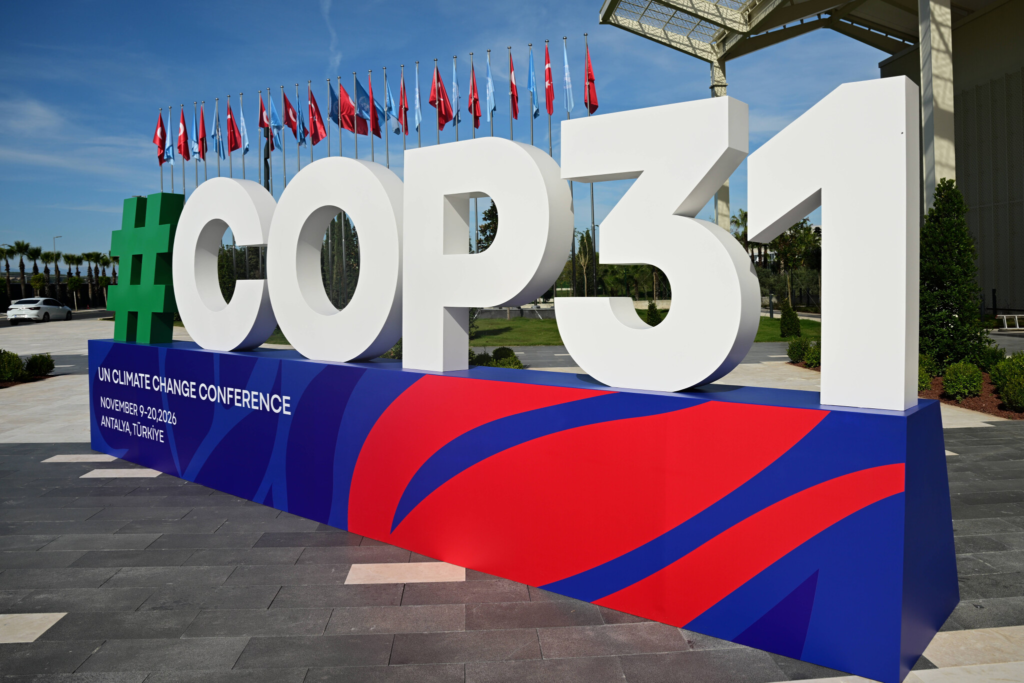
Delegates from around the world have arrived in Antalya, on Türkiye’s Mediterranean coast, for COP31, which runs from 9 to 20 November 2026 [1]. The to-do list is long, and much of it will sound familiar: money for climate action, deeper emissions cuts, adapting to impacts that are already here, and paying for loss and damage. So what can we realistically expect from two weeks of talks, and how will we know whether they worked?
So what is COP31, exactly?
COP is short for Conference of the Parties, the yearly meeting of the countries that have signed up to the UN Framework Convention on Climate Change [2]. On paper, it’s a gathering of governments hammering out international climate agreements. In practice, it has become a lot more than that.
These days, COP is also where countries, companies and cities come to announce new commitments. Activists turn up in force to draw attention to parts of the crisis they feel are being overlooked, and for a couple of weeks each year, climate change gets more public attention than at almost any other time.
The negotiations are still the heart of it. But around them, COP has grown into the world’s biggest annual stage for climate action.
What’s different this time?
This year’s conference is trying out an unusual way of running things.
Normally, the host country takes the COP presidency and steers both the negotiations and everything else happening at the summit. At COP31, that job has been split in two. Türkiye holds the presidency and leads the Action Agenda, while Australia, represented by its climate and energy minister Chris Bowen, serves as President of Negotiations [3][4]. The deal was struck at COP30 in Belém, ending a year-long standoff between the two countries over who would host [5].
The split matters. The presidency has real sway over the parts of COP that aren’t negotiated: the themes of the action agenda, the side initiatives, the headline announcements. Its grip on the formal talks is looser, because in the end the countries themselves decide what gets agreed.
On paper, the division of labour is clear. How smoothly it works in the room is another matter. Turkish officials have stressed that final decisions rest with the COP31 presidency, while Australia’s team says the two governments are working together seamlessly [6]. We’ll find out soon enough.
How far have we come since Paris?
There is real progress to celebrate. When the Paris Agreement was negotiated in 2015, the world was heading for a catastrophic 3.7–4.8°C (6.7–8.6°F) of warming by 2100 [7]. Since then, policy shifts and the rapid growth of clean energy have pulled that number down. Global solar capacity alone was more than ten times larger in 2025 than it was in 2015 [8].
The UN Environment Programme’s latest Emissions Gap Report, released in October, estimates that current policies put the world on course for about 2.8°C (5.0°F) of warming this century. If countries fully deliver on their latest climate pledges, that falls to around 2.6°C (4.7°F) [9]. That’s still a dangerous level of warming. But bending the curve down by a degree or more spares the planet some of the very worst consequences.
And the heat is already here. August 2026 tied July 2023 as the hottest month ever recorded worldwide [10].

What’s on the agenda in Antalya?
Much of the agenda will look familiar to anyone who has followed recent COPs: climate finance, faster emissions cuts, and funding for loss and damage in the countries that did the least to cause the problem. Of these, finance is likely to be the biggest fight in the formal negotiations [11].
Climate finance. Article 9.1 of the Paris Agreement says developed countries “shall provide” financial resources to developing nations for both mitigation and adaptation [12]. Who pays, how much, and in what form have been argued over ever since. In Antalya, developing countries will keep pressing richer nations to deliver on promises already made, including the COP29 goal of mobilizing at least $300 billion a year by 2035 and the COP30 call to at least triple adaptation finance over the same period. According to the OECD, developed countries provided and mobilized a record $136.7 billion in climate finance in 2024 [13]. Developing nations want the money faster and in larger amounts, and they point out that loans can deepen debt problems that are already serious. Developed countries, for their part, are feeling the squeeze from higher fuel costs at home.
Fossil fuels. What to say about fossil fuels has become a flashpoint at recent COPs. At COP30, a coalition of more than 80 countries backed a formal roadmap for moving away from them, but it didn’t make it into the final deal. The Belém Political Package left the words “fossil fuels” out of the official text entirely [14]. Vulnerable countries, civil society groups, environmental NGOs and others saw this as a major step back from the Glasgow Climate Pact (COP26), which called for phasing down unabated coal power and phasing out inefficient fossil fuel subsidies, and from the UAE Consensus (COP28), which explicitly called for transitioning away from fossil fuels. To calm things down, the COP30 presidency published the outlines of a voluntary roadmap ahead of COP31.
Emissions cuts. The formal agenda includes the Mitigation Work Programme, which is meant to speed up emissions reductions. But at a preparatory meeting in June, countries couldn’t agree on what it should actually do: drive concrete cuts, or remain a space for dialogue. Negotiators have also clashed over the Global Goal on Adaptation, including whether the formal text should mention the call to triple adaptation finance and how to design the metrics and indicators that track progress. The stakes are high. UNEP says global emissions need to fall 18% by 2030 and 45% by 2035, compared with 2025 levels, to hold peak warming to around 1.7–1.8°C [9].
Other issues. Expect discussion of the just transition mechanism that countries agreed to develop at COP30. It is meant to strengthen cooperation and offer technical support to economies moving away from carbon-intensive industries, but how it will work in practice is still unclear, and further talks on it are scheduled for Antalya.
Methane is another one to watch. Since the Global Methane Pledge was launched at COP26 in Glasgow, more than 150 countries have signed up to cut methane emissions at least 30% below 2020 levels by 2030 [15]. Methane is a powerful greenhouse gas, responsible for roughly a third of the warming we’re seeing today, and it plays an outsized role in near-term heating [16]. The good news is that cheap, proven fixes already exist, and using them now would slow the pace of warming. Many are hoping COP31 will push countries to go further, especially in the oil and gas sector.
Is COP worth all the effort?
Antalya isn’t the first COP the United States has sat out, but its continued absence comes at a critical moment, with growing questions about whether the process still works. The focus on implementation, a theme at COP30 as well, reflects a widely shared concern that these summits produce plenty of talk and pledges but not enough real action. That’s a fair criticism.
Still, there’s one thing COP does very well: it keeps climate change on the global agenda. Every year, countries know they’ll be expected to show up and, to some degree, lay bare what they have (or haven’t) done. The annual meeting also gives them a chance to build coalitions around urgent problems, such as cutting methane faster.
Nobody expects COP31 to be remembered for a single big breakthrough. But the fact that countries keep coming back to the table says something important: climate action, and the hope for a better future that comes with it, isn’t going away.
References
- IISD Earth Negotiations Bulletin, “Antalya UN Climate Change Conference – COP 31.” https://enb.iisd.org/antalya-un-climate-change-conference-cop31
- UNFCCC, “Conference of the Parties (COP).” https://unfccc.int/process/bodies/supreme-bodies/conference-of-the-parties-cop
- Prime Minister of Australia, “COP to be hosted by Türkiye with Australia leading negotiations” (media release, November 2025). https://www.pm.gov.au/media/cop-be-hosted-turkiye-australia-leading-negotiations
- IISD SDG Knowledge Hub, “COP 31 Presidency aims for secure global economy as climate impacts worsen” (April 2026). https://sdg.iisd.org/news/cop-31-presidency-aims-for-secure-global-economy-as-climate-impacts-worsen/
- UN Global Compact Network Australia, “Australia and Türkiye strike historic deal on COP31 leadership” (November 2025). https://unglobalcompact.org.au/?p=22277
- Climate Home News, “Türkiye says it has ‘final decision’ at COP31 despite Australia running negotiations” (September 2026). https://www.climatechangenews.com/2026/09/11/turkiye-says-it-has-final-decision-at-cop31-despite-australia-running-negotiations/
- IPCC, Climate Change 2014: Mitigation of Climate Change, Summary for Policymakers (AR5 WGIII). https://www.ipcc.ch/site/assets/uploads/2018/02/ipcc_wg3_ar5_summary-for-policymakers.pdf
- International Energy Agency, Global Energy Review 2026: Solar PV and wind. https://www.iea.org/reports/global-energy-review-2026/technology-solar-pv-and-wind
- UNEP, Emissions Gap Report 2026: The Point of Return (October 2026). https://www.unep.org/en/publications/report/emissions-gap-report-2026 — see also the UNEP press release: https://www.unep.org/news-and-stories/press-release/new-unep-report-lays-out-emission-cuts-needed-return-15degc
- Copernicus Climate Change Service, “August was world’s joint-hottest month on record.” https://climate.copernicus.eu/copernicus-august-was-worlds-joint-hottest-month-record-pushing-global-temperatures-back-above
- Council on Foreign Relations, “Understanding the Global Push for Climate Finance.” https://www.cfr.org/backgrounders/understanding-global-push-climate-finance
- UNFCCC, Paris Agreement (2015), Article 9. https://unfccc.int/sites/default/files/english_paris_agreement.pdf
- OECD, “Developed countries exceed USD 100 billion climate finance goal for third consecutive year” (May 2026). https://www.oecd.org/en/about/news/press-releases/2026/05/developed-countries-exceed-usd-100-billion-climate-finance-goal-for-third-consecutive-year.html
- COP30 Presidency, “COP30 approves Belém Package.” https://cop30.br/en/news-about-cop30/cop30-approves-belem-package1
- Climate and Clean Air Coalition, “Ministers urge decisive methane action as global report shows progress, warns of gaps.” https://www.ccacoalition.org/news/ministers-urge-decisive-methane-action-global-report-shows-progress-warns-gaps
- UNEP, “Ministers urge decisive methane action as global report shows progress” (Global Methane Status Report press release). https://www.unep.org/news-and-stories/press-release/ministers-urge-decisive-methane-action-global-report-shows-progress